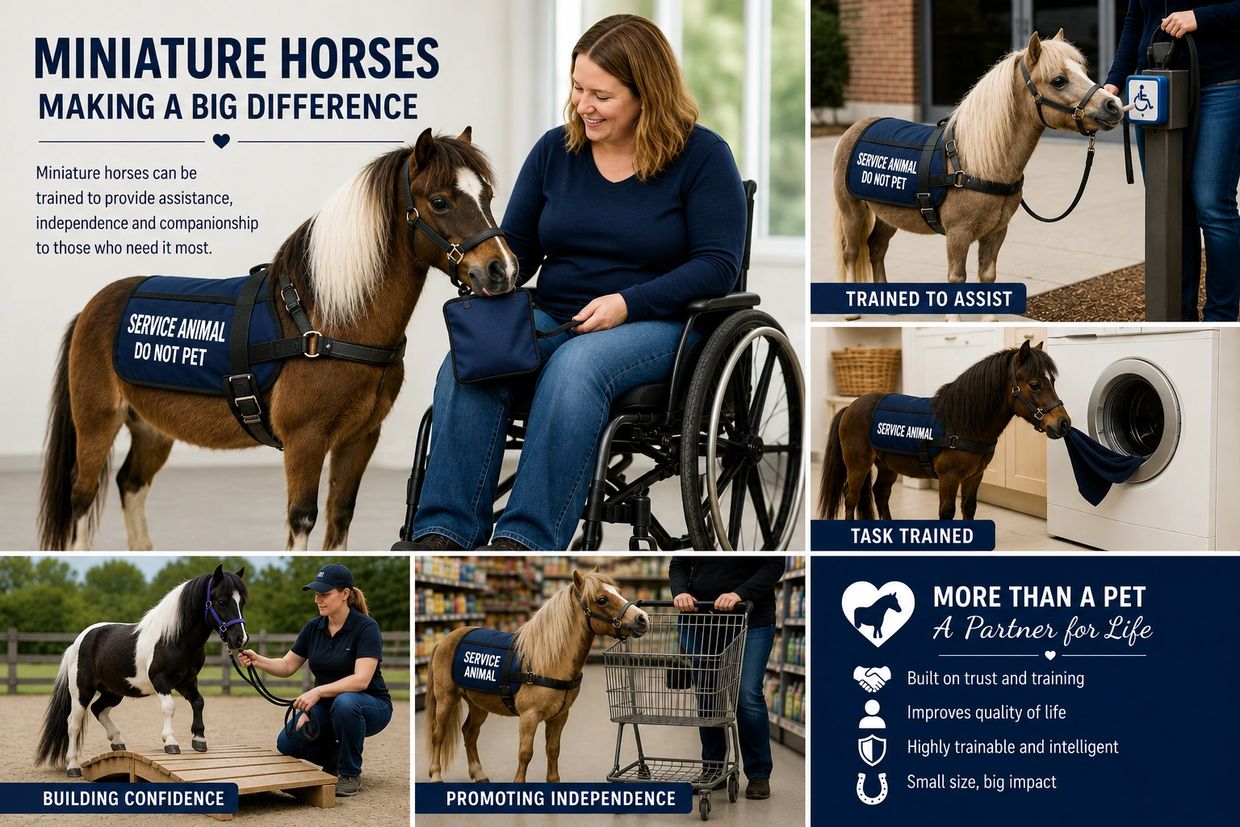
Miniature Horses as Service Animals
Under the Americans with Disabilities Act, miniature horses may be accommodated as service animals when they are individually trained to perform work or tasks for a person with a disability. The ADA recognizes miniature horses separately from service dogs and allows covered entities to assess whether a miniature horse can be reasonably accommodated in a specific setting.
Holistic Horsemanship Institute of America offers specialized evaluation and training for miniature horses being considered for service-animal work.
This program is designed for owners seeking a thoughtful, selective, and realistic process — one that evaluates the individual horse, develops appropriate public-access and task skills, and prepares the horse-handler team for daily life together.
Not every miniature horse is suited for service work. HHIA’s phased approach helps determine whether a candidate has the temperament, trainability, soundness, confidence, and reliability needed to continue through the program.
Training is customized whenever possible, with a focus on safe handling, public manners, practical assistance tasks, mobility-related support when appropriate, and long-term owner education.
A Phased Training Process
HHIA’s program begins with a preliminary assessment and, when appropriate, an in-person evaluation before a horse is accepted into training. Approved candidates then move through structured phases focused on foundation skills, public access, mobility and house manners, customized service tasks, and handler integration.
Detailed phase descriptions, fees, candidate requirements, and program limitations are outlined below.
Miniature Horses:
- Serve as guide animals or mobility/balance assistance animals
- Should be 24 -34 inches in height
- Weigh between 70-100 pounds
- Are housebroken
- Can push, pull or carry heavy objects
- Offer a long service life because they live 30-40 years or more
- Easy to groom and shed fewer allergens than dogs
- Great alternative service animal for those who cannot work with a dog for religious or cultural reasons
Start the Mini-Horse Service Animal Training Process
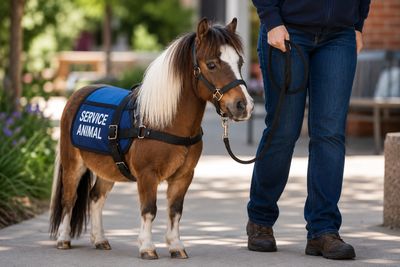
Candidate Requirements
- Miniature horse must be between 24" and 34" in height.
- Miniature horse must weigh between 70 and 100 pounds.
- Horse must be at least 2 years old.
- Mares and geldings only.
- Horse must be physically sound.
- Horse must possess a safe, manageable temperament.
Important Notes
- Horses between 2 and 3 years old may continue to grow.
- Horses that exceed size requirements at maturity may not be suitable for public-access work.
- Final acceptance is determined through the evaluation process.
- Acceptance into the program does not guarantee graduation. Horses may be released from training if they are no longer progressing appropriately, become unsound, or are determined to be unsuitable for service-animal work.
Evaluation Process Step 1 - Preliminary Candidate Assessment
Remote review of potential miniature horse service animal candidates:
- $200
- Application, photos, records, and video review
- Final evaluation provided in writing
Evaluation Process Step 2 - In-Person Candidate Evaluation
- $500 plus travel expenses (US and Canada - please inquire for overseas fees)
- Required before acceptance into the training program
Transportation
Owners are responsible for all transportation arrangements to and from the training facility.
Service Area
The program accepts candidates from the US and Canada. In-person evaluations may be conducted in the horse's location. All travel expenses are the responsibility of the owner.